The Rice Paddy as Japan’s Soul — Agriculture, Identity, and the Fight to Protect an Ancient Crop
By Yoshi | Japan Unveiled
Japan protects its rice the way some countries protect their nuclear weapons: with a seriousness that outsiders find disproportionate and that insiders find obvious. When the Uruguay Round of GATT negotiations concluded in 1994, forcing Japan to open its agricultural market to foreign rice imports, the political crisis in Tokyo was more intense than any purely economic calculation could justify. Finance ministers who had faced down currency crises and industry collapses without losing their composure were visibly distressed. The agricultural lobby — Japan’s nokyo, the agricultural cooperative federation — deployed the political machinery of a national emergency. The eventual compromise, which allowed a small amount of foreign rice into Japan under a minimum access quota while maintaining tariffs at levels that made commercial importation noncompetitive, was presented to the Japanese public not as a negotiating success but as a near-defeat that had been narrowly averted.
From a purely economic perspective, this reaction is bizarre. Rice agriculture in Japan is heavily subsidized, inefficient by international standards, practiced by an aging population on farms too small for mechanization to be fully effective, and producing a crop that costs the Japanese consumer several times what equivalent nutrition could be purchased for on the international market. The Japanese taxpayer pays, through the agricultural subsidy system, for the right to eat expensive domestically produced rice rather than cheap imported rice. By any conventional economic analysis, this is a bad deal.
But the conventional economic analysis misses what rice is in Japan. It is not merely a crop or a food source. It is the medium through which Japanese culture expresses its most fundamental ideas about identity, community, labor, the relationship between humans and the natural world, and what it means to be Japanese. To understand Japan’s rice obsession is to understand something that runs far deeper than agricultural economics.
Ten Thousand Years of Rice
Rice cultivation in Japan dates to approximately the third century BCE, when wet-rice (paddy) agriculture — the cultivation of Oryza sativa in flooded fields — arrived from the Asian continent through Korea and established itself in the western regions of Japan before spreading eastward over the following centuries. The adoption of wet-rice cultivation was the most transformative event in Japanese prehistory: it required the creation of irrigation systems that reorganized both the landscape and the social structures that managed it, it produced a surplus that could support non-agricultural specialists and the social hierarchy that managed their labor, and it established the seasonal calendar of planting and harvest that organized Japanese communities’ relationship with time for the next two thousand years.
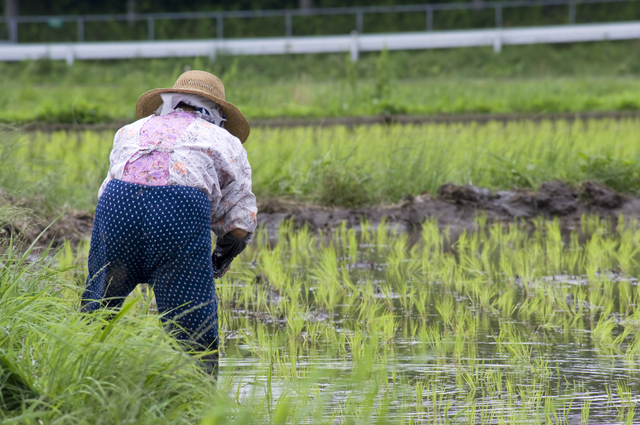
The specific qualities of Japanese wet-rice cultivation — the precise management of water levels at each stage of growth, the community labor of transplanting (taue), the collective harvest, the careful maintenance of the complex irrigation systems — created a social life organized around collective agricultural labor in ways that had profound long-term cultural consequences. The paddy field required cooperation. Individual farming of paddy rice was not meaningfully possible: the irrigation systems that served multiple farms were shared infrastructure that required coordinated maintenance and collective decision-making about water allocation. The community whose survival depended on this collective management developed the social muscles — the capacity for coordination, the norms of collective obligation, the mechanisms for managing conflict over shared resources — that shaped Japanese social organization for millennia.
The Shinto connection between rice and the sacred is ancient and still operationally present in Japanese religious practice. The imperial household performs rice cultivation rituals (otaue-matsuri) in which the emperor himself plants and later harvests a symbolic crop of rice in a paddy maintained within the Imperial Palace grounds. This ritual is not ceremonial theater but a genuine expression of the understanding, embedded in Shinto theology, that the emperor’s role includes maintaining the relationship between the human community and the divine forces that make the rice grow. The first rice harvested each autumn is offered to the gods before it is consumed by humans — the niiname-sai ritual, in which the emperor offers new rice to the deities, is one of the most ancient and most carefully maintained ceremonies in the Shinto calendar.
The Taste Question — Why Japanese Rice Is Different
Japanese rice — the short-grain, high-starch variety known as japonica, distinct from the long-grain indica varieties that dominate in most of the world — has specific culinary properties that make it suited to Japanese cuisine in ways that imported rices are not. Its stickiness when cooked is essential for forming onigiri, for eating with chopsticks, and for the texture of sushi rice. Its moisture content, the specific balance of the two starch types (amylose and amylopectin) that determine how it behaves when cooked and cooled, and its subtly sweet flavor are qualities that Japanese cooks have selected for over centuries of agricultural development.
The premium varieties of Japanese rice — Koshihikari, Sasanishiki, Akitakomachi, Hitomebore, Haenuki — are the subject of a connoisseurship among Japanese consumers that is analogous to wine connoisseurship among French consumers, in the sense that the specific variety, the specific growing region, and the specific year’s harvest are all considered relevant to the evaluation of quality. The prefectural governments of major rice-producing regions — Niigata, Akita, Yamagata — invest in agricultural research and brand development for their regional rice varieties in the same way that French wine regions invest in the promotion of their appellations.
Niigata’s Koshihikari is perhaps the most prestigious rice variety in Japan — a distinction that Niigata’s prefectural government and agricultural cooperative invest considerable effort in maintaining and promoting. The specific environmental conditions of the Niigata rice-growing region — the mineral-rich snowmelt water from the Echigo mountains, the cold nights that allow the rice plant to build starch more efficiently, the clay-heavy soil — are understood to produce a Koshihikari that is superior to Koshihikari grown elsewhere, and the premium that Niigata rice commands in the domestic market reflects this understanding.
Tanbo Art — The Rice Paddy as Canvas
One of the most unexpected expressions of Japan’s relationship with rice cultivation is the phenomenon of tanbo art — rice paddy art, in which farmers plant multiple varieties of rice with differently colored leaves to create enormous pictorial designs visible from elevated positions. The practice began in Inakadate village in Aomori prefecture in 1993, as part of a rural revitalization effort aimed at attracting visitors to a depopulating farming community. The first designs were relatively simple — a few colored varieties planted in patterns visible from the nearby hillside. The technique has developed over thirty years into something of astonishing sophistication.
Contemporary tanbo art designs can cover paddy fields measuring several thousand square meters and depict complex figurative subjects — historical scenes, anime characters, local cultural symbols — in a combination of green, yellow, purple, red, and brown rice varieties that produces color palettes of surprising range and subtlety for a medium whose components are limited to plant leaves. The planning requires the use of GPS surveying equipment and design software to translate the image into a planting grid, and the planting itself is a labor-intensive community effort in which the design grid is transferred to the paddy field and the different rice varieties planted in their designated positions by hand. The full image is visible only after the rice plants have grown to sufficient height — typically in July and August, before the harvest in September and October — and the period of visibility is brief relative to the year-round labor that produces it.
The tanbo art movement has spread from Aomori to dozens of other communities across Japan, each developing its own designs and its own traditions around the practice. The designs at major tanbo art sites draw tens of thousands of visitors each season — a significant achievement for communities that would otherwise have little to offer as tourist destinations — and the practice has been featured in international media as an example of the intersection of traditional agriculture and contemporary creativity that Japan occasionally produces. It is also, in a way that the participants appear to understand, a form of tribute to the paddy field itself: using the cultivation of rice as a medium for art is a way of paying attention to the craft and the beauty of something that Japanese society tends to take for granted.
The Agricultural Crisis — Who Will Farm the Paddies
Japan’s rice agriculture faces an existential challenge that the policy debate over rice tariffs has obscured but that is in many ways more urgent: the farmers are old, and there are not enough young people choosing to replace them. The average age of Japanese farmers was approximately sixty-eight in the most recent agricultural census — a figure that represents not the average age of agricultural workers but the average age of agricultural household heads, meaning the people who actually make the decisions and hold the land. The pipeline of younger people entering farming is significantly smaller than what is needed to replace the generation that is aging out of active farming over the next decade and a half.
The specific character of rice agriculture in Japan — small-scale, labor-intensive, economically marginal — makes it less attractive to younger people who have options. A rice paddy of one hectare, managed as a family farm without significant mechanization, produces an income that cannot support a modern household’s consumption needs. Most rice farmers in Japan have jobs outside agriculture that provide their primary income, and farm the paddy on weekends and seasonal leave as a secondary activity maintained for cultural, family, or subsidy-related reasons. The subsidy system — which supports rice farmers with direct payments that make the activity economically rational even when the market price of rice would not — is the policy mechanism that maintains the farming even when the economics would otherwise suggest abandonment.
The landscape consequences of agricultural abandonment — the terrace paddies reverting to scrub, the irrigation channels silting up and collapsing, the satoyama landscape transforming into undifferentiated secondary forest — are significant, and I have discussed them in the context of the akiya crisis. The cultural consequences are harder to quantify but no less real: the knowledge of how to farm rice, how to read the water level in a paddy, how to manage the specific pest and disease challenges of wet-rice cultivation, how to maintain the irrigation infrastructure — this knowledge is accumulated over lifetimes and transmitted through communities, and when the farming population drops below a certain threshold, the transmission chain breaks. What was known in a community for two thousand years can be lost in a generation.
Rice and Japan’s Future Self
The debate about rice in Japan is, at its deepest level, a debate about what Japan is and what it wants to be. A Japan that fully liberalizes its rice market — that accepts the economic logic of importing cheap rice and reallocates the land and labor of rice agriculture to more productive uses — is a Japan that has decided that its rice culture, like its traditional crafts, is a heritage to be appreciated rather than a practice to be maintained. A Japan that continues to subsidize and protect domestic rice agriculture despite the economic costs is a Japan that has decided that some things are worth paying for that a price system alone cannot capture.
I do not think the choice is simple, and I am suspicious of people who think it is. The economics of maintaining uncompetitive agriculture through permanent subsidy are real and have real costs. The cultural value of the paddy landscape, the social bonds of rice-farming communities, the knowledge that lives only in the practice of the thing — these are also real and have real costs if lost. Japan will have to navigate between these realities, as it has been navigating since the first trade negotiators demanded access to its rice market, and the navigation will not produce a clean resolution. It will produce the kind of messy, contested, imperfect outcome that reflects the genuine difficulty of the trade-offs involved.
What I know, after forty years of living here, is that when a Japanese person talks about rice — complains about the price, celebrates a particularly good new-season harvest, defends the agricultural subsidy with a passion that seems disproportionate — they are not talking only about food. They are talking about themselves. The rice is them, or some version of them that they are not ready to let go. That is not a policy argument. But it is a real thing, and it matters.
— Yoshi 🌾 Central Japan, 2026
Enjoyed this? Continue with: “The 8 Million Empty Houses” and “Japan’s Earthquake Psychology” — both available on Japan Unveiled.