Why Japanese Convenience Store Food Is Actually Gourmet
By Yosi | WASHOKU (Japanese food)
Let me say something that might sound strange.
Some of the best food I have ever eaten in Japan did not come from a restaurant. It did not come from a market stall, or a grandmother’s kitchen, or a famous chef with a Michelin star.
It came from a convenience store.
I know how that sounds. In many countries, “convenience store food” means a sad hot dog rotating under a heat lamp, or a bag of chips eaten in a parking lot. It means food you eat because you have no other choice.
In Japan, it means something completely different.
First, You Need to Understand the Konbini
In Japanese, convenience stores are called konbini (コンビニ). There are roughly 55,000 of them across the country. The three biggest chains — 7-Eleven, Lawson, and FamilyMart — are everywhere. In cities, you can find one on almost every block. In small towns, the konbini is often the center of community life.
They are open 24 hours a day, 365 days a year. You can pay your electricity bill there. You can print documents. You can buy concert tickets, pick up packages, and withdraw cash. In an earthquake or typhoon, they become emergency supply stations.
But the food. Let’s talk about the food.
The Onigiri That Changed Everything
If you want to understand konbini food, start with the onigiri.
An onigiri is a rice ball — usually triangular, wrapped in seaweed, filled with something savory in the center. They cost around 120 to 180 yen. That is roughly one dollar.
And they are extraordinary.
The rice is cooked to a specific texture — slightly firm on the outside, soft in the middle. The seaweed is kept in a separate inner wrapper so it stays perfectly crisp until the moment you open it. The fillings range from classic (salted salmon, tuna with mayonnaise, pickled plum) to seasonal specials that rotate throughout the year.
Konbini chains employ food scientists and professional chefs to develop their onigiri recipes. They run taste tests. They study how the rice behaves at different temperatures. They fine-tune the salt content down to the fraction of a percent.
This is not an accident. This is craft.
The Chilled Bento: A Complete Meal for 500 Yen
Next to the onigiri, you will find the bento boxes.
A typical konbini bento contains rice, a main protein (grilled fish, karaage fried chicken, braised pork, or beef), and two or three small side dishes — maybe a portion of tamagoyaki, some simmered vegetables, or a little salad. Everything is portioned carefully. Everything is seasoned well.
You heat it in the microwave near the register, and within 90 seconds you have a hot, balanced meal.
The price? Usually between 400 and 600 yen. Less than five dollars.
Now, is a konbini bento as good as a meal at a proper restaurant? Not always. But it is often better than you would expect from almost anywhere else in the world at that price point. The seasoning is careful. The rice is good. The fish, if it is grilled fish, actually tastes like grilled fish.
Why? Because the major konbini chains work directly with food manufacturers under extremely strict quality agreements. Shelf life, temperature management, ingredient sourcing — all of it is controlled and audited constantly.
The Sandwiches That Make No Sense (In the Best Way)
Japanese konbini sandwiches deserve their own paragraph.
They come in the familiar triangular plastic containers, crusts cut off, filled with things like egg salad, strawberries and whipped cream, or katsu (breaded pork) with tonkatsu sauce.
The egg salad sandwich is the one that people talk about. It is soft and just sweet enough and somehow deeply satisfying in a way that is hard to explain. Food writers from around the world have written about it. Some have called it one of the great sandwiches on earth.
I have eaten egg salad sandwiches in other countries. They do not taste like this.
Part of the secret is the bread — a milk bread called shokupan that is pillowy and slightly sweet. Part of it is the egg mixture, which is creamier and more delicate than what you find elsewhere. And part of it is simply attention to detail — the kind of obsessive care that Japanese food culture applies to everything, even a 200 yen sandwich.
Seasonal Specials: The Konbini Calendar
One thing that surprises visitors is how much konbini food changes throughout the year.
In winter, you find oden — a hot pot of fish cakes, daikon radish, tofu, and eggs simmered in a light soy broth, kept warm in a pot right on the counter. You pick what you want, the staff ladles it into a cup, and you eat it standing up or take it to eat in the cold outside. It is humble food, but on a cold January night, it is exactly right.
In summer, there are cold noodle dishes, chilled soups, and refreshing citrus desserts. In spring, sakura-flavored everything appears — sakura mochi, sakura lattes, sakura-shaped chocolates.
Lawson is especially known for its seasonal desserts. Their premium roll cake — a Swiss roll with a cloud of fresh cream inside — has a dedicated fan following. People visit multiple times a week just to check what is new.
The Sweets Counter: Where Things Get Serious
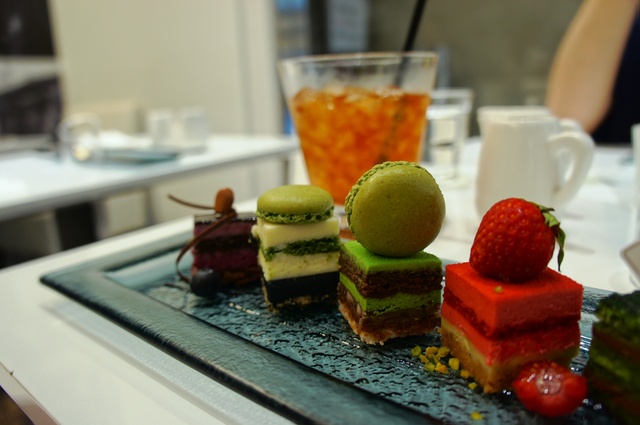
Let me be direct: Japanese konbini desserts are very good.
The pudding (purin) — a smooth, jiggly caramel custard — is a classic. It has been refined and re-refined over decades until it achieves a silky texture that rivals what you would find in a proper patisserie.
The cream puffs (shū krim) are filled with fresh custard and are best eaten within a few hours of purchase.
The strawberry shortcake slices in a small plastic case are made with actual fresh strawberries, actual whipped cream, and actual soft sponge cake.
None of these cost more than 300 yen. Most cost less.
I have taken visitors to Japan who, by the end of their trip, were skipping restaurant desserts to go back to the konbini instead.
Why Is It So Good?
There are a few reasons, and they all connect to something deeper about Japanese food culture.
The first is competition. Three massive chains fighting for the same customers means that quality improvements happen constantly. If 7-Eleven improves their onigiri, Lawson has to respond. If FamilyMart launches a new dessert that sells out, the others are watching.
The second is customer expectation. Japanese consumers are demanding. They notice when the rice texture changes. They write about it online. They stop buying. This keeps standards high in a way that is uniquely Japanese.
The third is the philosophy of everyday quality. In Japan, there is no widespread cultural belief that cheap food is allowed to be bad. A 150 yen onigiri is still expected to be made well, seasoned correctly, and handled with care. This expectation runs through every level of the food industry — from street vendors to high-end kaiseki restaurants.
A Personal Note
I have lived in central Japan for most of my life. I have eaten at beautiful restaurants, at family tables, at festival stalls.
But there are mornings when I stop at the konbini on my walk, pick up an onigiri and a hot coffee from the machine by the door, and stand outside for a few minutes eating breakfast in the quiet early light.
It costs less than two dollars. It tastes like Japan.
That is the thing about konbini food. It is not gourmet in the way that word is usually used — not rare ingredients or elaborate techniques or small portions on large plates.
It is gourmet in the way that matters more: made with care, made consistently, and made for the person who is hungry right now, with exactly one dollar in their pocket.
In Japan, that person deserves good food too.
And that, I think, says everything about why Japanese food culture is something the world should pay more attention to.
Hi, I’m Yosi — a Japanese food lover based in central Japan. I write about washoku to help the world understand what makes Japanese food so special, one bowl at a time.