Japanese Fast Food: How McDonald’s, KFC, and MOS Burger Became Japanese
By Yoshi | Japan Unveiled
In December 1971, the first McDonald’s in Japan opened its doors on the Ginza in Tokyo — the most prestigious commercial street in the country, in a location that, if anything, communicated the seriousness with which the franchise’s Japanese partner Den Fujita intended to introduce American fast food to Japanese consumers.
The opening day sales were approximately 3 million yen — a figure that set a record for a first-day McDonald’s opening globally.
Japan became one of McDonald’s most significant international markets. It also became the market in which the most extensive and most creative adaptation of the McDonald’s template occurred — in which the American fast food corporation encountered a food culture with its own deeply specific tastes, its own seasonal consciousness, its own specific understanding of what fast food should be, and discovered that adaptation was not optional.
The story of American fast food in Japan is the story of how American fast food became Japanese — and in becoming Japanese, revealed something about both Japanese food culture and the specific nature of cultural adaptation.
McDonald’s Japan: The World’s Most Creative Adaptation
McDonald’s Japan — Nihon McDonald’s — is the most-visited fast food chain in Japan and one of the most creatively active branches of the global McDonald’s corporation.
The specific adaptations that McDonald’s Japan has developed across its five-decade presence constitute a genuinely interesting catalogue of Japanese food preference.
The Teriyaki Burger. The Teriyaki McBurger — a beef patty with teriyaki sauce and mayonnaise — was introduced in Japan in 1973 and has never left the menu. It is now available in McDonald’s locations globally, making it one of the few regional adaptations that traveled back to the global menu from Japan. The specific combination of the sweet teriyaki glaze and the Japanese mayonnaise richness on a burger is specifically Japanese in its flavour logic and specifically excellent in a way that the menu’s international spread reflects.
The Tsukimi Burger. The Tsukimi (moon-viewing) burger — a limited edition autumn item featuring a soft-fried egg that references the full moon of the autumn moon-viewing season — is one of the most specifically Japanese adaptations of any global fast food chain item. The egg is placed to resemble the moon; the specific timing aligns with the jugoya (harvest moon) period. A hamburger that is both fast food and a specific seasonal cultural reference is a specifically Japanese achievement.
The Seasonal Menu Culture. McDonald’s Japan operates on a seasonal limited-edition menu rotation that is more elaborate and more frequent than any other McDonald’s market. The specific strategy — releasing items that are only available for specific windows, creating the specific consumer urgency of the limited product — is the meibutsu logic applied to fast food. The seasonal McDonald’s item in Japan generates the specific social media discussion and the specific consumer urgency that the broader Japanese limited-edition culture produces.
Regional Items. Japan is divided into specific regional zones with specific regional menu items — a practice that reflects both the Japanese understanding of regional food identity and the specific commercial logic of making each region’s McDonald’s visit slightly different from another region’s.
KFC Japan: The Christmas Revolution
Kentucky Fried Chicken Japan is, in the international context of the KFC franchise, the most culturally significant anomaly.
KFC is not Christmas food in the United States. It is not Christmas food in any country from which KFC originates or in which it operates at significant scale. In Japan, it is not merely Christmas food — it is the primary Christmas food, consumed by approximately forty million Japanese people on December 25th each year.
The origin of this extraordinary cultural positioning is both well-documented and genuinely remarkable. In 1974, KFC Japan launched a marketing campaign called Kurisumasu ni wa Kentakkii! (Kentucky for Christmas!) that promoted a specific Christmas meal package — a bucket of KFC chicken, marketed as an alternative to the Western tradition of turkey at Christmas. The campaign was successful. The success was reinforced in subsequent years. The tradition, once established, became self-reinforcing: KFC at Christmas is what Japan does because KFC at Christmas is what Japan does.
The Christmas KFC phenomenon requires planning. The specific Party Barrel packages — which include fried chicken, specific side items, and sometimes a Christmas cake — are available for advance order from early November and sell out through pre-order well before December 25th. The walk-in customer on Christmas Day will find KFC stores with queues extending onto the street.
I have eaten Christmas KFC approximately twenty times in my life. It is good KFC — Japan’s KFC quality is genuinely high — eaten in a context that has accumulated enough cultural weight that the context is itself part of the eating experience. The family gathered around the red bucket, the specific sides, the Christmas cake — this is a specific Japanese Christmas tradition that is genuinely warm despite its entirely commercial origin.
MOS Burger: Japan’s Original Challenger
MOS Burger — the Japanese fast food chain founded in Tokyo in 1972 — is the most significant purely Japanese fast food brand and the one that most clearly demonstrates the specific character of Japanese fast food development.
MOS Burger’s founding premise was a direct challenge to the McDonald’s quality proposition: Motto Oishii (even more delicious) was the aspiration embedded in the chain’s name (MOS — Mountain Ocean Sun in the official version, but the initial association was with the quality proposition). The specific quality focus — freshly prepared burgers, ingredients of higher quality than the McDonald’s standard, a menu that developed specifically Japanese items alongside the burger format — produced a chain that has sustained a loyal following across fifty years.
The specific MOS Burger innovations:
The Mos Rice Burger. The raisu bāgā — a burger in which rice patties replace the bread bun — is the most specifically Japanese fast food innovation of the past several decades. The rice is compressed and briefly grilled to form a specific structure that holds together without becoming sticky. The fillings — kinpira gobō (stir-fried burdock and carrot), teriyaki chicken, various other Japanese preparations — are chosen for their compatibility with the rice rather than with bread. The result is a fast food item that is fundamentally Japanese in its structure rather than an adaptation of a Western format.
The Seasonal and Regional Menu Rotation. MOS Burger’s menu rotation is even more elaborate than McDonald’s Japan’s — the specific seasonal ingredients, the specific regional items, and the specific limited-edition collaborations create a constantly evolving menu that rewards repeat visits in a way that a static menu does not.
The Freshness Positioning. MOS Burger’s specific quality proposition — slower to prepare than other fast food, made to order rather than assembled in advance — has maintained a customer base that specifically chooses MOS Burger when time is less critical than quality. The MOS Burger wait is understood as a quality signal; the customer who waits five minutes for a freshly prepared burger is receiving a better product than the customer who receives an immediately available assembled one.
Yoshinoya and Sukiya: The Gyudon Empires
The gyudon (beef rice bowl) chains — Yoshinoya, Sukiya, and Matsuya — are a specifically Japanese fast food category with no close equivalent in any other fast food culture globally.
Gyudon — thinly sliced beef and onion simmered in a sweet soy sauce broth, served over rice — is one of the most satisfying combinations in Japanese comfort food. The gyudon chains have made this combination available at extraordinary speed (a typical gyudon meal is served within thirty seconds of ordering), extraordinary affordability (typically 350 to 500 yen for a standard portion), and extraordinary consistency (the specific flavour is consistent across hundreds of locations nationally).
The specific culture of the gyudon chain: the U-字型 (U-shaped) counter layout that places the kitchen on the inside and the customers on the outside, allowing minimal footprint and maximum throughput. The gyūdon sanshu no jingi — the three sacred implements of gyudon eating, informal but widely observed: the specific positioning of the soy sauce, the pickled ginger, and the seven-spice mix (shichimi) that are the standard condiments.
Yoshinoya in particular has a specific corporate history that is worth noting: the company went bankrupt in 1980 when beef prices spiked after the Iranian Revolution made beef import costs unsustainable for a 300-yen beef bowl. The company restructured, survived, and continues operating. The specific corporate memory of the 1980 crisis has shaped Yoshinoya’s approach to ingredient cost management ever since.
Ramen Chains: The Mid-Tier Fast Food
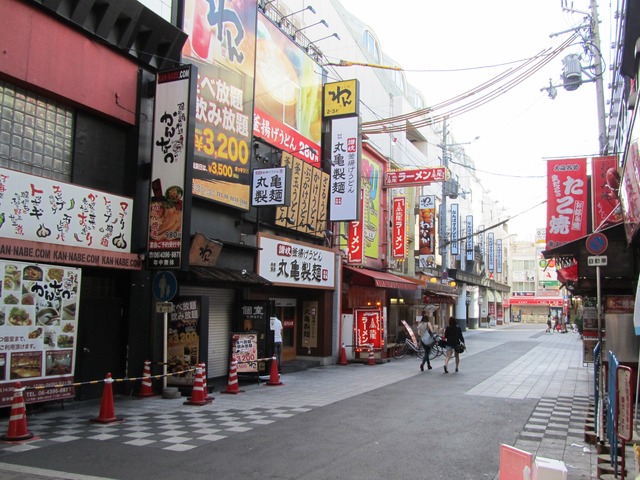
The national ramen chains — Ichiran, Tenkaippin, Kourakuen, Hidakaya — occupy a specific position in the Japanese fast food landscape that is different from the Western fast food chains and the gyudon chains.
Ramen is not fast food in the conventional sense — it requires preparation time that the gyudon chains’ thirty-second service cannot match. But the ramen chains have developed a specific fast food version of ramen: standardised, reliable, affordable, and available at consistent quality across many locations.
Ichiran — the chain most internationally famous, with locations in Japan, Hong Kong, and New York — is specific for its solo eating booths: individual booths where a single diner is separated from their neighbours by wooden dividers, ordering through a paper form slipped under a bamboo curtain to invisible staff, eating in complete privacy. The Ichiran system was developed specifically to allow the customer to focus entirely on the ramen — to eliminate the social dimension of the eating experience and to make the ramen itself the complete subject of attention.
For visitors to Japan, the Ichiran booth experience is one of the most specifically Japanese fast food experiences available — simultaneously efficient, slightly lonely, and producing a specific quality of focused attention to the food that group eating cannot generate.
Conbini Hot Food: The Fast Food Nobody Talks About
No discussion of Japanese fast food is complete without acknowledging the specific category of hot food available at Japanese convenience stores — which is, by any reasonable measure, one of the most democratically available and most consistently good fast food systems in the world.
The conbini hot food counter — the heated display case near the register that holds nikuman (steamed buns), fried chicken (karaage), oden (in winter), corn dogs, hashimaki (thin omelette with soy sauce), and various other items — is the most visible expression of Japanese convenience store food quality that I have written about elsewhere on this blog.
The specific achievement: hot, acceptable-to-good quality food, available at all times, at low prices, from a location available within walking distance of virtually any point in Japan’s urban areas. The convenience store as fast food — not replacing the dedicated restaurant but providing an alternative that is genuinely satisfying for the specific moment when speed and convenience are the primary requirements — is one of the more remarkable achievements of Japanese retail food culture.
— Yoshi 🍔 Central Japan, 2026
Enjoyed this? You might also like: “Japanese Convenience Store Food Is Actually Gourmet” and “Ramen Shop Culture: The Unspoken Rules of Eating at a Japanese Ramen Counter” — both available on Japan Unveiled.