Tofu: Why Japan’s Most Misunderstood Food Deserves More Respect
By Yoshi | Japan Unveiled
Tofu has an image problem.
In the international imagination — particularly in the English-speaking world — tofu occupies a specific cultural position: it is the food of people who do not eat meat, the protein substitute that is understood to require doctoring with strong sauces and spices to be edible, the food that is eaten not because it is good but because it is healthy and the person eating it is virtuous.
This image is so thoroughly wrong that addressing it requires some firmness.
Tofu is a genuinely excellent food. Not a compromise, not a substitute, not a health food eaten despite its flavour — an excellent food with its own specific flavours, its own specific textural pleasures, and its own specific culinary applications that are not attempted because tofu is an acceptable alternative to something better but because tofu is specifically the best ingredient for those applications.
The tofu that produces the “boring health food” response in most Western encounters with it is not the same thing as the tofu of Japanese cooking. The watery, flavourless block from the refrigerated section of the supermarket, eaten cold and unadorned or cooked in a way that is unaware of what tofu specifically can do — this is not a fair representation of what the ingredient is.
I want to tell you what tofu actually is.
What Tofu Is
Tōfu (豆腐) — the characters mean “bean curd” (tō = bean, fu = curd) — is made from soy milk in a process directly analogous to the making of cheese from dairy milk.
Soybeans are soaked, ground with water, heated, and strained to produce tonyu (soy milk). The soy milk is then treated with a coagulant — traditionally nigari (a seawater concentrate containing primarily magnesium chloride), or alternatively calcium sulfate (gypsum), glucono delta-lactone (GDL), or various combinations — that causes the proteins and fats in the soy milk to coagulate into curds. The curds are collected and pressed (to varying degrees, depending on the type of tofu being produced) to produce the finished product.
The analogy to cheese is precise and useful. Different coagulants produce different textures and different flavour characteristics, just as different cultures and different production processes produce different cheeses from the same dairy milk. The degree of pressing determines the firmness and moisture content of the finished tofu, just as the aging and pressing of cheese determines its texture. The quality of the soy milk — the soybean variety, the water quality, the careful extraction — determines the fundamental flavour character of the finished tofu, just as the quality of the milk determines the fundamental character of the cheese.
The Types: Understanding the Spectrum
Japanese tofu exists across a spectrum of textures determined by the coagulant used, the pressing applied, and various other production variables. The major categories:
Momen tofu (木綿豆腐) — “cotton tofu,” named for the cotton cloth (momen) used to line the pressing mold, which leaves characteristic surface texture markings. Momen tofu is the firmer variety, pressed to remove more water, with a slightly grainy texture compared to softer varieties and a more concentrated soy flavour. It holds its shape during cooking, making it appropriate for stir-frying, frying, grilling, and preparations that require the tofu to maintain structural integrity.
Kinugoshi tofu (絹ごし豆腐) — “silk-strained tofu,” named for the silk cloth used in its production. Kinugoshi is produced by setting the soy milk directly with coagulant in the final container, without pressing — the result is softer, smoother, more uniform in texture, with a higher water content and a more delicate, custard-like quality. Kinugoshi is appropriate for preparations where the tofu’s texture is the primary subject: hiyayakko (cold tofu), miso soup, and preparations where the tofu should yield immediately rather than provide resistance.
Silken tofu — in the international market, “silken” is used as a translation of kinugoshi, though the specific production methods vary by manufacturer. At its best, silken tofu has a custard-like smoothness and a clean, delicate soy flavour.
Yaki-dofu (焼き豆腐) — momen tofu that has been grilled or broiled to produce a lightly browned, slightly firm surface. Yaki-dofu is specifically used in sukiyaki, where its surface holds up to the sweet-savoury warishita sauce without breaking down as readily as uncooked tofu.
Abura-age (油揚げ) — thin slices of tofu that have been deep-fried, producing a puffy, golden exterior with a specific chewy texture. Abura-age is used as an ingredient in miso soup, in inari-zushi (the seasoned abura-age pouches stuffed with rice that are one of Japan’s most popular sushi varieties), and in various simmered preparations where its porosity — its ability to absorb the flavours of surrounding liquids — makes it useful.
Atsu-age (厚揚げ) — thick pieces of tofu deep-fried to produce a firm, browned exterior while maintaining the interior texture of the original momen tofu. Atsu-age can be sliced and grilled, simmered in various preparations, or eaten with soy sauce and grated ginger.
Kōya-dofu (高野豆腐) — freeze-dried tofu, produced by freezing tofu and allowing it to desiccate slowly over several weeks. The result is a sponge-like dried product that, when rehydrated in dashi-based cooking liquids, absorbs those liquids and swells to produce a uniquely textured ingredient with an extraordinary capacity for flavour absorption. Kōya-dofu is one of the most specific and most impressive Japanese food products — the specific process of freeze-drying was developed at the high-altitude Buddhist monastery areas (the Kōya in the name is Kōya-san, the sacred mountain temple complex of Wakayama Prefecture) where winter temperatures are reliably cold enough for the process.
The Flavour Question: What Tofu Actually Tastes Like
The most important thing to understand about tofu’s flavour is that good tofu does not taste like nothing.
Good tofu — made from quality soybeans, with appropriate coagulant, produced with care — has a specific, delicate, slightly nutty, slightly sweet, specifically soy-adjacent flavour that is present but not dominant. It is the flavour of soymilk concentrated and solidified, refined and cleaned of the rawer notes of the bean by the production process.
This flavour is subtle. It is not the assertive flavour of strong cheese or cured meat. It requires some attention to perceive clearly, and it is easily overwhelmed by aggressive seasoning. But it is there, it is specific, and it is genuinely pleasant.
The experience of eating hiyayakko — chilled kinugoshi tofu with a small amount of soy sauce, a small amount of grated ginger, and a small amount of katsuobushi — is an experience of this specific flavour presented with minimal intervention. The soy sauce amplifies the tofu’s existing savouriness; the ginger adds brightness; the katsuobushi adds umami depth. The tofu’s own flavour is the primary subject, supported rather than replaced by the accompaniments.
This is the correct approach to tofu — using accompaniments that enhance its specific character rather than substituting for it.
The Tofu Specialist: Japan’s Tofu Makers
Japan has a tradition of specialist tofu makers — tofu-ya — that is analogous to the artisan cheesemaker or the specialist baker in other culinary traditions. The quality of tofu varies significantly between the mass-produced tofu available at supermarkets and the hand-made tofu produced by specialist makers using traditional techniques and specific local soybeans.
The specific variables that distinguish artisan tofu from mass-produced tofu:
Soybean quality and variety. Different soybean varieties produce tofu with different flavour profiles and different textures. The specific regional soybean varieties — including varieties that have been cultivated in specific areas for generations — produce tofu with character that is specific to their origin, analogous to the terroir of wine production.
Water quality. The mineral content of the water used in tofu production affects both the flavour of the soy milk and the behaviour of the coagulant. The specific water quality of different regions of Japan is one factor in the specific character of regional tofu traditions.
Coagulant type and application. The specific coagulant used — nigari versus calcium sulfate versus GDL, and the specific source and purity of the nigari — affects the texture and flavour of the finished tofu significantly. Nigari-made tofu typically has a more complex flavour than GDL-made tofu; the specific concentration and application technique of the coagulant affects the texture.
The Kyoto tofu tradition — specifically the obōsan tofu (priest’s tofu) of the Buddhist temple cooking tradition — is one of the most celebrated regional tofu traditions in Japan. The high-quality silken tofu used in Kyoto temple cooking — where tofu has historically played the central protein role in the vegetarian diet — is produced with specific attention to the delicacy and flavour that this culinary role demands.
How to Eat Tofu Properly
Hiyayakko — cold kinugoshi tofu, dressed simply with soy sauce, grated ginger, and katsuobushi. The essential tofu dish, the one that reveals the ingredient’s specific character most clearly. It should be made with quality kinugoshi and eaten immediately after dressing — the katsuobushi waves in the warmth of the soy sauce, the ginger provides brightness, and the tofu provides its specific clean, delicate flavour.
Agedashi tofu — momen tofu cubed and briefly deep-fried, placed in a light dashi broth seasoned with soy sauce and mirin, topped with grated daikon and grated ginger. The exterior of the fried tofu dissolves slightly into the broth as the dish rests, thickening it and creating the specific thick, silky sauce that makes agedashi tofu one of the most satisfying tofu preparations.
Mapo tofu (mabō dōfu) — the Sichuan Chinese dish, adopted into Japanese home cooking in a specific Japanese form that is milder than the original. Ground pork, tofu, and a specific sauce of fermented black beans (dōubānjiàng) and chili. The Japanese version uses kinugoshi tofu, which breaks down and melds with the sauce in a way that momen tofu does not.
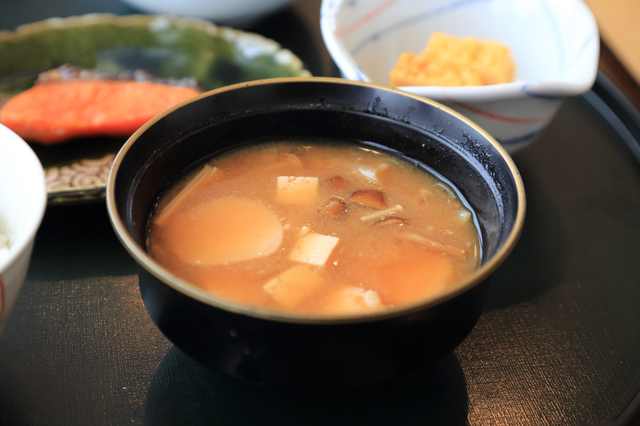
Miso soup with tofu — either momen or kinugoshi, depending on preference. The tofu absorbs the miso’s flavour during cooking and provides the specific protein and textural element that transforms miso soup from a condiment into a component of a balanced meal.
— Yoshi 🫘 Central Japan, 2026
Enjoyed this? You might also like: “Miso Soup: The One-Bowl Philosophy That Defines Japanese Cooking” and “The Japanese Diet: Why Japanese People Live So Long” — both available on Japan Unveiled.